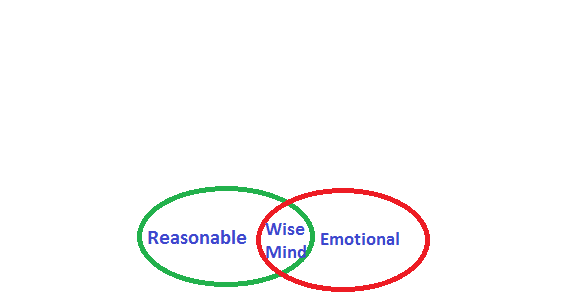
Webster’s Dictionary defines dialectical: a method of examining and discussing opposing ideas in order to find the truth.
Dialectical behavioral therapy was adopted from the mindfulness meditation traditions that go back thousands of years. It has been very effective in treating those with symptoms of borderline personality.
In the previous post, Fear of Abandonment, I described how everyone has some abandonment fear but in the borderline personality diagnosis it is extreme.
Why then is Dialectical Behavior Therapy or dbt therapy so effective for those who can generally not find much help?
Because meditation has simple methods to effectively relate with the mind and body, particularly with feelings, memories and distress.
We all need to respond carefully when big feelings get triggered. Otherwise, the feeling can take us over and we may do or say something harmful to ourself or another.
Meditation techniques teach us to observe our feelings without judgement the best we can. We try not to identify with them or repress them, just allow them to come and go. When we take our feelings too personally, we can get lost, confused and possessed by a story that may have nothing to do with the present situation.
Observing our feelings and thoughts with a non-judgmental attitude is also the work of psychotherapy. “Let’s just see what comes up”. This kind of openness provides us with “what is”.
DBT works because it is a practice. When we have something to practice, we have something to focus on, keep us centered, and something to hold on to that helps keep our feet in reality.
The borderline sufferer did not have that guidance with feelings in the younger years. Therefore, these methods of relating to the mind help us to develop ego strength and ego intelligence that did not develop earlier.
Then with practice, this objective intelligence can help us determine what to do with various feelings and how to respond to various situations with more grace.
For example, let’s say someone said something to me, it could be anything. Something they said triggered something in me. I can first begin to notice I am feeling very angry. Then, I become aware of the anger without doing anything with it, except just feel. Feel it without repression or acting out on someone. Be with it for a bit. Maybe even saying to myself, “I am feeling angry now”. This is practicing a non-judgmental attitude. I can then stay a little calmer by also feeling the breath. I can stay with this inner experience until I make a decision of what to do.
Or, I could impulsively yell “fuck you” (judge the other person and act out). Or, impulsively decide “only weak people have anger” (judge myself for feeling angry). Or, push the feelings away through a distraction, such as, an addiction.
That brings me to the next reason Dialectical Behavior Therapy works.
It helps to distinguish a feeling that was activated from the past that has little, or nothing, to do with the person I am with now.
Continued example: As I become aware of the anger, I also feel my breathing to stay grounded and endure the discomfort. Through keeping my mind with the breath, I am able to feel the anger and not react, quite as much. As I stay with the anger and the breath (this takes practice), I am able to notice that I might not have understood the meaning of what this person said to me.
Because I can stay with the feeling and the breath, I decide what to do. Ask the person “What did you mean by that”, instead of saying, ”fuck you”. I find out through my question that it had nothing to do with me. He/she was coming from a completely different place. He/she was not demeaning me(they were just frustrated), and I assumed that it was about me.
Even though DBT is described as a behavioral therapy it is coming from a background of wisdom and compassion that is found in Buddhist meditation. This particular behavior therapy may extend into a more loving way of living, with a wisdom that can distinguish fantasy and reality.
For information on Dialectical Behavior Therapy:
http://behavioraltech.org/resources/whatisdbt.cfm
>
